



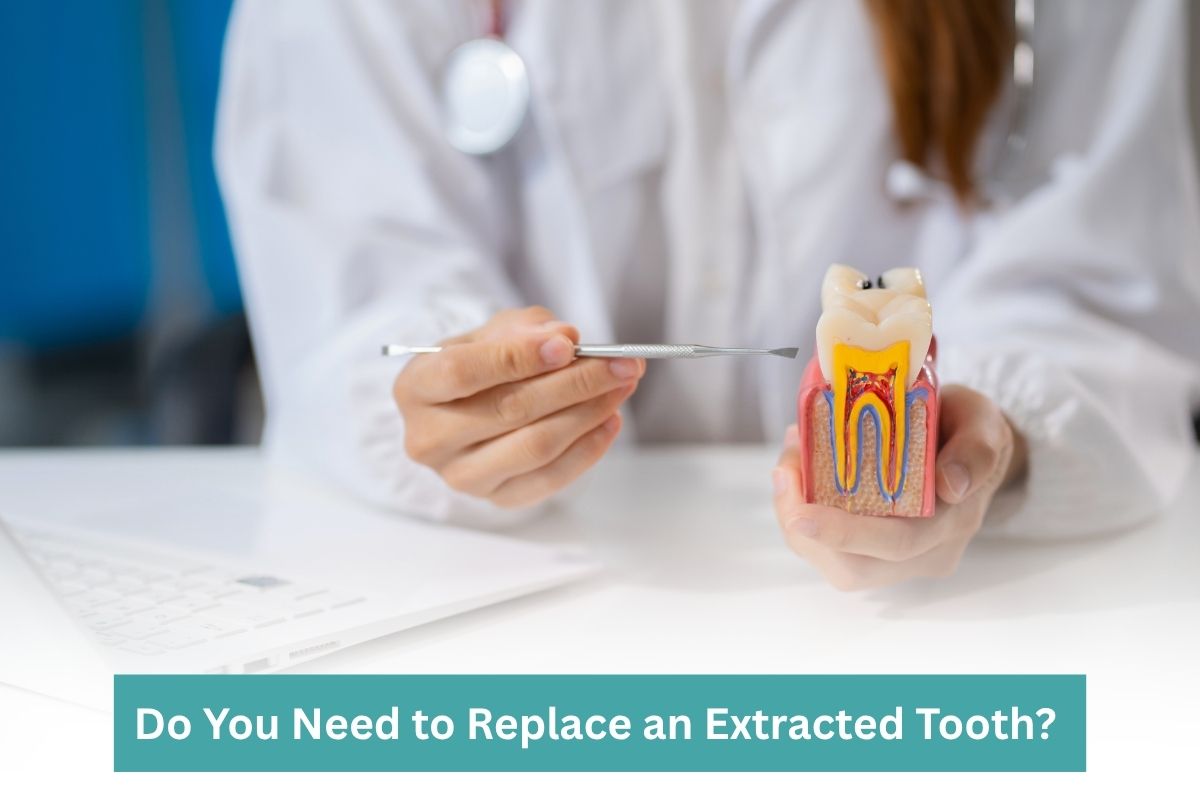
Having a tooth removed can bring immediate relief, especially if it was causing pain or infection. Once the area begins to heal, it is easy to assume the problem is fully resolved. However, the absence of a tooth can quietly set off a chain of changes that affect how your teeth function, how your jaw supports them, and how your smile looks over time.
Understanding whether you should replace an extracted tooth is an important step toward protecting your long-term oral health and avoiding more complex issues down the road.
What Happens After a Tooth Is Extracted?
When a tooth is removed, your mouth does not simply adapt without consequences. Several biological and structural changes begin soon after the extraction.
- Bone loss begins: The jawbone depends on stimulation from tooth roots. Without that stimulation, the bone in that area gradually starts to shrink.
- Teeth begin shifting: Nearby teeth may drift into the empty space, leading to alignment issues.
- Opposing teeth can over-erupt: A tooth in the opposite arch may move into the gap, affecting your bite.
- Changes in bite and pressure: Missing even one tooth can alter how force is distributed when chewing.
These changes often happen slowly, which makes them easy to overlook until they become more noticeable or harder to correct.
Located in the Aspen Hill area of Silver Spring, our office, Aspen Hill General & Cosmetic Dentistry, follows a conservative and personalized approach to dental care. Whether you had your extraction done with us or at another office, we offer tooth replacement options to help restore function and stability. Our dentists, including Dr. Goorah, Dr. McLaughlin, and Dr. Nguyen, are dedicated to ensuring every step of your care is carefully planned and tailored to your individual needs.
At our office, the decision to replace an extracted tooth is always based on a thorough clinical evaluation. During your checkup, we assess factors such as bone health, tooth position, bite alignment, and overall oral condition to determine the most appropriate treatment for you. To understand your options properly, we invite you to call our office at (301) 460-1212.
Is It Always Necessary to Replace a Missing Tooth?
There are a few cases where replacement is not required, such as after wisdom tooth removal. However, for most teeth, especially those that play a role in chewing or are visible when you smile, replacement is strongly recommended.
Leaving a gap untreated can lead to:
- Increased strain on surrounding teeth
- Greater risk of gum concerns
- Difficulty chewing certain foods
- Gradual changes in facial appearance
A professional evaluation helps determine the best course of action based on your specific oral condition.
Tooth Replacement Options to Consider
Several options are available to replace a missing tooth. Each one restores your smile in a different way, but they do not all offer the same long-term benefits or clinical outcomes.
Dental Implants
Dental implants are widely considered one of the most complete solutions because they replace both the visible tooth and its root.
Key advantages include:
- Helps preserve jawbone structure
- Functions like a natural tooth
- Does not rely on adjacent teeth
- Long-lasting and stable
- Supports overall oral health
At our office, dental implants are typically recommended as the first-line treatment when clinical conditions allow. Because they integrate with the jawbone, they help maintain both function and bone integrity, making them a predictable long-term solution.
However, treatment recommendations are always based on a thorough evaluation and individual preferences. In situations where implants may not be suitable due to clinical factors such as bone volume, medical considerations, or when an individual prefers a non-surgical approach, alternative options are carefully considered.
Dental Bridges
A dental bridge is a fixed restoration that replaces a missing tooth by utilizing the adjacent teeth for support.
Clinical considerations include:
- Requires preparation of neighboring teeth
- Does not provide stimulation to the underlying bone
- May be indicated when adjacent teeth already require crowns
Bridges can be an appropriate option when implant placement is not indicated or when a fixed, non-removable solution is preferred without surgical intervention.
Partial Dentures
Partial dentures are removable prosthetic appliances designed to replace one or more missing teeth.
Clinical considerations include:
- Removable in nature and less stable than fixed restorations
- May require periodic adjustments for fit and comfort
- Limited in preventing long-term bone changes
Partial dentures may be recommended when multiple teeth are missing or when other fixed options are not feasible. They can also serve as an interim solution during a phased treatment plan.
Why Many People Choose Dental Implants After Extraction
While several tooth replacement options are available, dental implants are often preferred because they address both function and long-term oral health. Unlike other options that primarily focus on restoring appearance, implants help maintain the natural structure of the jaw.
When a tooth root is replaced with an implant, it continues to stimulate the bone, which plays a key role in preventing bone loss. This helps preserve facial structure and keeps surrounding teeth stable.
At our Silver Spring office, dental implant treatment is planned with a focus on comfort and success. Our dentists evaluate each case carefully to ensure that implant placement is both safe and predictable.
When Should You Replace an Extracted Tooth?
Timing plays a critical role in how simple or complex your treatment may be.
- Early replacement helps preserve bone and prevents neighboring teeth from shifting
- Delaying treatment can lead to bone loss, which may require additional procedures such as bone grafting
- Long-term gaps may limit available treatment options and affect overall oral function
In many cases, planning your tooth replacement soon after extraction allows for a more straightforward and effective treatment process.
Planning to replace your missing tooth in Silver Spring?
Our office operates with extended hours on weekdays to support your dental health needs and accepts patients with same-day appointments from all nearby areas, including Glenmont, Layhill, and Rossmoor.
What to Expect During the Dental Implant Process
Dental implant treatment is completed in phases to ensure proper healing and long-term stability.
Comprehensive evaluation: Digital imaging and clinical examination are used to assess bone quality, spacing, and overall oral health
Implant placement: The implant is carefully placed into the jawbone to act as an artificial root
Healing and integration: The bone gradually integrates with the implant, creating a strong foundation
Final restoration: A custom crown is placed to restore appearance and function
Each step is planned with precision to ensure that the final result looks natural and functions comfortably.
Choosing the Right Dental Team for Tooth Replacement
Replacing a missing tooth is a significant step toward restoring your confidence and oral health. It is not just about picking a procedure; it is about choosing a team that excels in comprehensive planning and long-term results. Whether you are considering the permanent stability of dental implants, the seamless fit of a dental bridge, or the versatility of partial dentures, the skill and diagnostic precision of your dentist are the most important factors in your success.
At Aspen Hill General & Cosmetic Dentistry, we treat every smile as unique as you are. Conveniently located on Connecticut Avenue in the heart of Silver Spring, our office serves as a trusted hub for restorative care for patients throughout the Aspen Hill and Wheaton communities.
If you have recently had a tooth extracted or are planning one, this is the right time to explore your replacement options. Acting early can help prevent bone loss, shifting teeth, and more complex treatments in the future.
Protect Your Oral Health After Tooth Extraction
An extracted tooth may resolve an immediate concern, but leaving the space untreated can lead to gradual changes that affect your oral health over time. Bone loss, shifting teeth, and bite changes can become more complex if not addressed early.
Replacing a missing tooth is not only about restoring appearance. It plays a critical role in maintaining function, balance, and long-term oral health. With the right timing and the right approach, you can protect your smile and avoid future complications.
